

A Pivotal Moment
When Shirlene was thirteen, her childhood ended abruptly.
She grew up in a family marked by dysfunction—where neglect and emotional harm were constant, and safety was never guaranteed. In the midst of it all, she witnessed a devastating loss that no child should ever have to carry.
Shirlene did not yet have the language for trauma. She only knew that something inside her had shattered.
In the years that followed, grief and distress surfaced in ways she couldn’t explain. Eventually, her struggles led to inpatient care. With support from professionals and child protection services, a decision was made for Shirlene to be placed at HCSA Dayspring.
She remembers being told she was going “somewhere else”—removed from home overnight.
Even when home is painful, it can still feel like the only thing you’ve ever known. For Shirlene, leaving intensified a deep, underlying wound: the feeling of being alone and abandoned… of being “too difficult” for anyone to take responsibility for.
That was how she arrived at Dayspring—carrying grief, fear, and a quiet belief that people eventually leave.
Steps on the Path to Healing
What Shirlene found at Dayspring was something she had never experienced before: consistency.
No one expected her to heal quickly. The care team journeyed with her patiently—helping her navigate boundaries, trust, and what it meant to receive and give care safely. It was not always easy. Healing rarely is.
But they stayed.
Years passed. Then more years.
Seven years on, Shirlene can say this with certainty: Dayspring did not abandon her.
Today, she calls it her second—maybe even third—home. Not in a symbolic way, but in the most practical, grounding sense. When life feels unstable, when she needs help, when she needs a safe place to land, Dayspring is where her mind goes first.
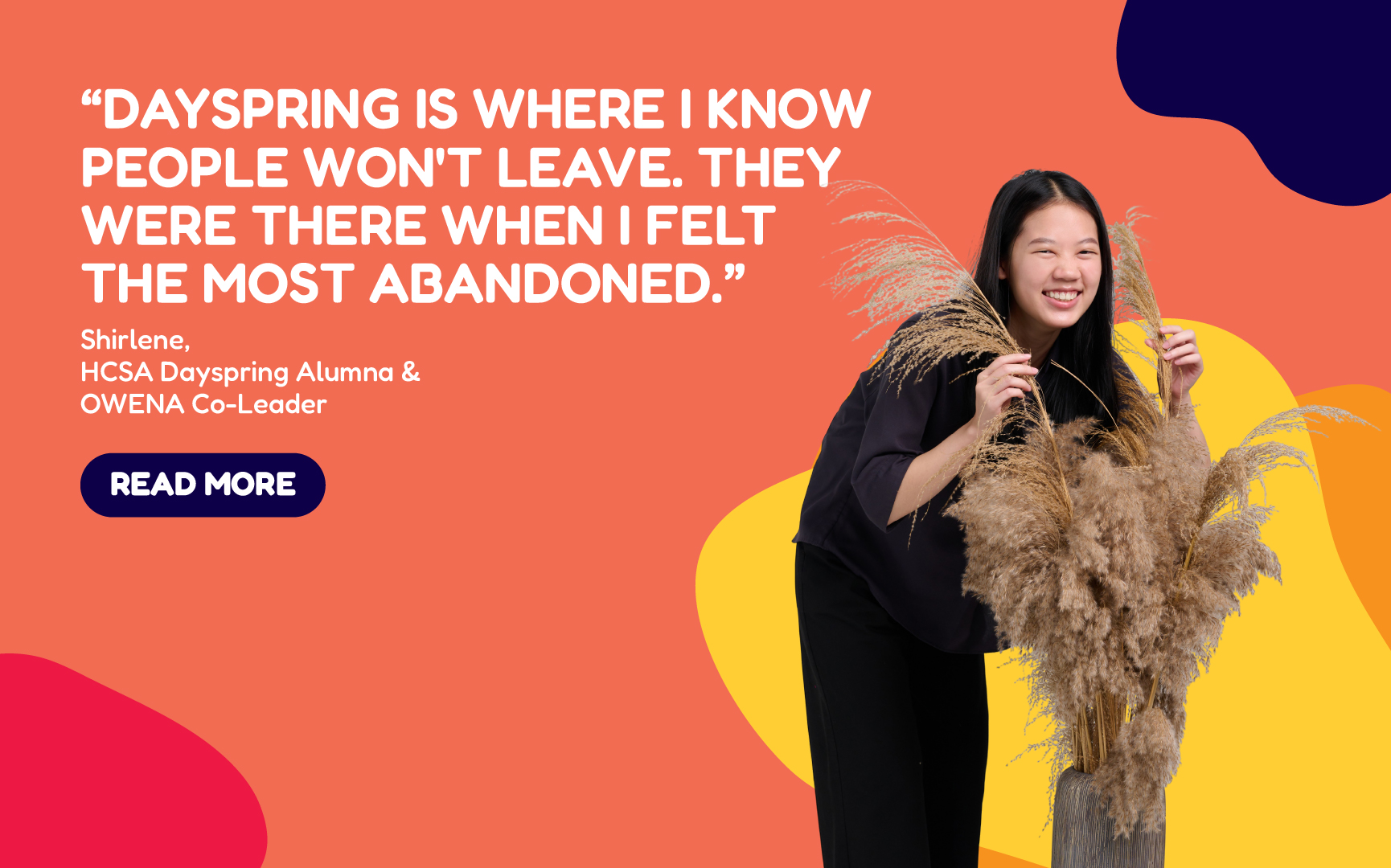
Dayspring is where I know people won’t leave. They were there when I felt the most abandoned.
Shirlene
Healing in the Small Things
For Shirlene, healing did not arrive as one dramatic breakthrough. It showed up in small, steady moments—the kind that quietly rebuild what trauma breaks: trust.
It looked like staff who remembered her. Welcome that didn’t fade no matter how often she returned. The growing sense of safety—eventually, even warmth.
Because of her past, Shirlene struggled with touch. Even a handshake could feel unsafe. Hugs were unthinkable.
At first, the care team respected that boundary. They offered something gentler instead: a calm presence, a quiet check-in, a reassuring pat on the head—care that did not demand anything from her, but simply stayed close enough to be felt.
Over time, trust grew.
Now, Dayspring is the only place where Shirlene feels safe enough to receive hugs—real, unguarded ones.
It’s the only place where the one thing I can’t give or receive outside—I can do it here. That’s how safe Dayspring is for me.
Shirlene
Healing, for Shirlene, also meant learning how to build a life beyond survival.
With ongoing support, she worked toward independence—taking on multiple jobs, managing her finances with intention, and choosing long-term stability over short-term comfort. Over time, her living situation improved too.
Some relationships remained distant. Family members could coexist under one roof and still feel worlds apart—more like housemates than relatives. Yet even in that reality, Shirlene discovered something new: family can also be chosen.
Not everyone is able to return to what they came from. But everyone deserves somewhere they can belong.
Finding Purpose in OWENA
That sense of belonging deepened through OWENA—Dayspring’s alumni community, a circle of young women who continue to support one another beyond their time in residential care.
Today, Shirlene gives back as an OWENA leader, walking alongside others who are still learning how to trust, how to cope, how to hope. Some days, the weight of it can feel heavy.
But then she sees the impact: a younger girl showing up again after disappearing for weeks, someone speaking up for the first time, someone trying—quietly, bravely—one more time.
“That’s when I remember why I do this,” Shirlene says. “That’s where my purpose is.”
Her hope, for a long time now, has been simple: to be happy. To have a safe place to stay. To help the people around her.
And perhaps most beautifully, she has learned to find joy not only in big milestones, but in everyday life—in the little things she loves: hot dog buns, big blankets, green tea, fishballs.
It’s a kind of wisdom that feels hard-won: when you learn to notice small joys, you start to realize that life can hold joy every day—and that is something worth staying for.
A Message of Hope
If there is one thing Shirlene would want others in similar situations to know, it is this: don’t walk alone.
Healing often begins with connection—safe people, steady support, and a community that can hold hope for you when you can’t yet hold it for yourself. For Shirlene, that community was Dayspring, and later, OWENA.
Her story is not about a single moment of rescue. It is about long-term accompaniment—about staying when it would be easier to leave, about rebuilding trust slowly, and about what can grow when someone is given the time and space to heal.
Today, Shirlene is still journeying. But she is no longer journeying alone.
And she is helping others believe—day by day—that they don’t have to do it alone either.
Where to get help:
Samaritans of Singapore Hotline: 1767
Institute of Mental Health’s Helpline: 6389 2222
Singapore Association for Mental Health Helpline: 1800 283 7019
You can also find a list of international helplines here. If someone you know is at immediate risk, call 24-hour emergency medical services.